
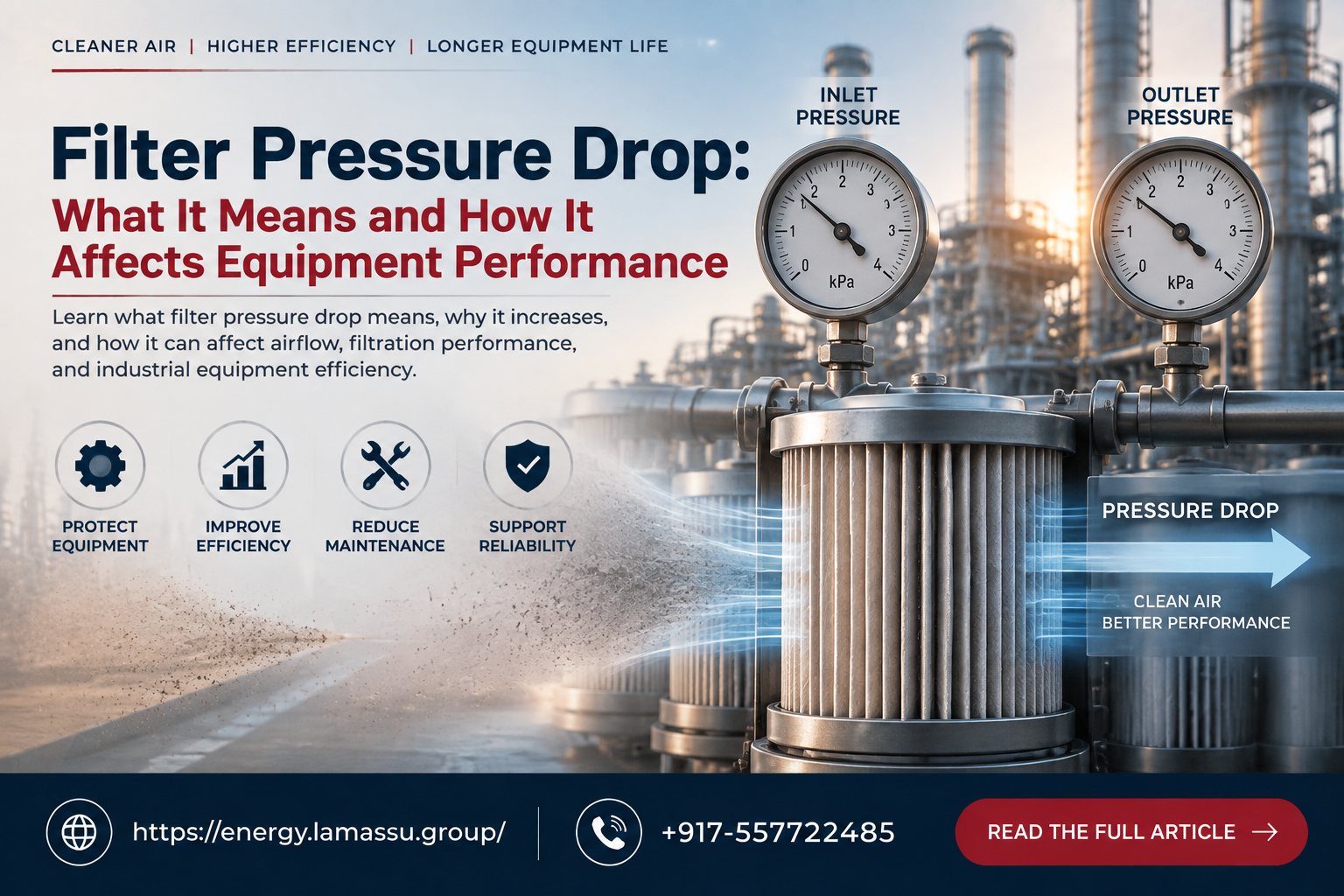
Learn what filter pressure drop means, why it increases, and how it can affect airflow, filtration performance, and industrial equipment efficiency.
What Is Filter Pressure Drop?
Filter Pressure Drop is the difference in pressure measured before and after a filter while air gas or liquid passes through it. It represents the resistance created by the filter against the flow.
ASHRAE defines pressure drop as the difference in pressure between two points in a flow system and notes that resistance to airflow is commonly referred to as pressure drop.
In industrial applications this measurement is important because a filter must remove contaminants while still allowing the required flow to pass through the system.
A new filter usually has a relatively low initial resistance. As contaminants accumulate on the filter media resistance can increase. If the pressure drop becomes too high the system may experience reduced airflow increased energy requirements or changes in equipment performance.
This makes pressure drop an important parameter when evaluating Filter Performance and determining whether a filtration system is operating within its intended conditions.
Why Does Filter Pressure Drop Matter?
The purpose of an industrial filter is to control contamination without creating an unacceptable restriction in the system.
A filtration system therefore needs to balance two important characteristics:
Contaminant Removal + Acceptable Flow Resistance
If a filter has insufficient filtration performance it may allow excessive contaminants to reach downstream equipment. If resistance becomes excessive the equipment may not receive the airflow or fluid flow it requires.
ASHRAE identifies particle removal efficiency resistance to airflow service life and life-cycle cost among the important characteristics used to evaluate air-cleaning equipment.
For industrial facilities this balance can affect:
- Equipment performance
- Airflow
- Energy consumption
- Maintenance requirements
- Filter service life
- Operational reliability
What Causes Filter Pressure Drop to Increase?
An increase in Pressure Drop Across Filter does not always indicate that the filter itself is defective. Several operating and environmental factors can influence the measurement.
Filter Loading
One of the most common causes is the accumulation of dust and other contaminants on the filter media.
As particles collect on the filter the resistance to airflow can increase. ASHRAE notes that pressure drop rises during dust loading and that the test may continue until a manufacturer’s specified maximum operating resistance is reached.
This is why monitoring differential pressure can provide useful information about filter condition.
High Airflow
The amount of air moving through a filter can influence its resistance.
When airflow increases the filter may experience greater resistance depending on its design and operating characteristics.
For this reason a pressure-drop reading should always be considered together with the actual operating flow rather than interpreted as an isolated number.
Incorrect Filter Selection
A filter that is not properly matched to the system may create excessive resistance or fail to provide the required contamination control.
Filter selection should consider:
- Required airflow
- Filtration efficiency
- Contaminant characteristics
- Equipment requirements
- Available filter area
- Operating environment
Dust and Environmental Contamination
Industrial facilities operating in dusty environments can experience faster filter loading.
This is particularly relevant to power generation and industrial facilities exposed to desert dust or airborne particles.
A filter that performs well in a relatively clean environment may experience a different loading pattern in a heavily contaminated environment.
Moisture and Humidity
Moisture can also affect filter behavior depending on the filter media system design and the contaminants present.
In some environments moisture can combine with airborne particles and increase resistance or create additional filtration challenges.
Environmental conditions should therefore be considered when evaluating Filter Pressure Drop.
How Is Filter Pressure Drop Measured?
Filter Pressure Drop Calculation starts with measuring the pressure upstream and downstream of the filter.
The basic concept is:
Pressure Drop = Upstream Pressure − Downstream Pressure
The actual measurement method depends on the filtration system and application.
Differential pressure gauges pressure transducers or other suitable measurement devices may be installed across the filter to monitor the difference.
ASHRAE describes the use of manometers static-pressure differential gauges and pressure transducers for measuring pressure drop across filter banks.
For industrial equipment the measurement points should be selected appropriately so the readings represent the actual resistance of the filter rather than unrelated pressure losses elsewhere in the system.
Filter Pressure Drop Calculation: What Factors Matter?
Although the basic pressure difference is straightforward the interpretation of the result requires more context.
Important factors include:
Airflow Rate
The same filter can show different resistance characteristics at different airflow rates.
Filter Design
Media type pleat configuration surface area and construction can influence resistance.
Filter Loading
As contaminants accumulate filter resistance may increase.
Operating Environment
Dust humidity temperature and other environmental factors can affect filtration behavior.
System Configuration
Housing design sealing bypass and upstream or downstream components can influence the overall pressure measurement.
Therefore Filter Pressure Drop Calculation should be considered as part of the complete filtration system rather than as a single number viewed independently.
Air Filter Pressure Drop and Equipment Performance
Air Filter Pressure Drop matters because air filtration systems are part of a larger airflow system.
When resistance increases the system may need to work harder to maintain the required airflow. Depending on the equipment design this can influence energy consumption or available airflow.
ASHRAE notes that increased filter efficiency can also result in increased pressure drop and that excessive pressure drop may affect airflow in systems that cannot accommodate the added resistance.
The relationship is therefore not simply:
Higher Efficiency = Worse Performance
Modern filter designs can achieve high efficiency without necessarily creating excessive resistance. What matters is whether the selected filter provides the required filtration performance within the operating limits of the equipment.
Does Higher Filter Efficiency Always Mean Higher Pressure Drop?
Not necessarily.
It is common to discuss filtration efficiency and pressure drop together because both are important filter characteristics. However the relationship depends on filter design media construction airflow and operating conditions.
ASHRAE research has shown that the relationship between efficiency and pressure drop is not necessarily a strong direct correlation across all filters and that actual system performance can differ from laboratory results.
This is an important consideration when comparing filtration products.
The objective should be to select a filter that provides the required contamination control while maintaining acceptable resistance and service life.
What Is an Acceptable Filter Pressure Drop?
There is no single acceptable filter pressure drop that applies to every industrial filtration system.
The appropriate limit depends on:
- Filter design
- Equipment manufacturer requirements
- Airflow
- System configuration
- Filter application
- Operating conditions
- Initial resistance
- Maximum allowable resistance
Using a generic pressure-drop number without considering the equipment can lead to incorrect maintenance decisions.
Instead, facilities should establish suitable operating limits based on the filter manufacturer’s specifications and the requirements of the equipment in which the filter is installed.
Gas Turbine Filter Pressure Drop
Gas Turbine Filter Pressure Drop is particularly important because gas turbines require large quantities of air for operation.
The air intake filtration system must remove harmful contaminants while allowing sufficient airflow toward the compressor.
As filters become loaded with dust the pressure drop may increase. If the system cannot compensate for the additional resistance the resulting airflow change can affect turbine operating conditions.
For gas turbine facilities this makes pressure-drop monitoring a useful part of air intake filtration management.
However, pressure drop should not be analyzed alone. It should be considered alongside:
- Airflow
- Compressor performance
- Filter condition
- Ambient conditions
- Turbine operating data
- Filter efficiency
This provides a more complete understanding of whether filtration is contributing to a performance issue.
Gas Turbine Air Intake Filters and Pressure Drop
Gas Turbine Air Intake Filters must balance contamination control with airflow requirements.
The air entering a turbine can contain dust sand moisture salt and other airborne contaminants. In challenging environments these contaminants can accumulate on filter media and change the filter’s resistance over time.
The relationship can be summarized as:
Environmental Contamination → Filter Loading → Increased Resistance → Potential Airflow Impact
This does not mean every increase in pressure drop creates a turbine performance problem. The significance of the change depends on the turbine system its operating point and the filter’s specified operating range.
For more information about the broader role of filtration in turbine operation see our guide to Gas Turbine Air Intake Filters.
Filter Pressure Drop in Hot and Dusty Environments
Industrial facilities in hot and dusty regions face unique filtration challenges.
In Middle Eastern markets such as the UAE Saudi Arabia Iraq Jordan and Kuwait airborne dust can place additional loading demands on air filtration systems.
The main concerns may include:
- Faster filter loading
- Increased maintenance requirements
- Higher pressure drop
- Compressor contamination
- Changes in airflow
- More frequent filter evaluation
Temperature and humidity can also influence the operating environment.
For this reason filtration strategies should be based on actual site conditions rather than relying only on standard assumptions about filter life.
How Filter Pressure Drop Affects Filter Performance
Filter Performance should be evaluated using more than one measurement.
A useful assessment can consider:
- Filtration efficiency
- Pressure drop
- Airflow
- Dust loading
- Service life
- System operating conditions
A filter may have excellent particle removal characteristics but still be unsuitable if its resistance is incompatible with the equipment.
Similarly a filter with very low resistance may not provide the required level of contamination control.
The best filtration solution is therefore one that provides an appropriate balance between protection and system performance.
How to Monitor Pressure Drop Across a Filter
Regular monitoring makes it easier to identify changes before they become operational problems.
A practical monitoring process can include:
Establish a Baseline
Record the pressure drop of a clean or properly operating filter under defined conditions.
Monitor During Operation
Track pressure-drop readings while the equipment operates.
Compare Trends
Look for gradual increases rather than focusing only on a single measurement.
Consider Airflow
A change in airflow can affect pressure-drop readings, so operating conditions should be considered.
Review Filter Condition
Physical inspection and operating data can help explain unexpected changes.
Compare With Manufacturer Limits
Use the filter and equipment specifications to determine when additional evaluation or replacement may be appropriate.
This trend-based approach provides more useful information than simply waiting until a filter appears visibly dirty.
When Should a Filter Be Replaced?
Filter replacement should not be based solely on appearance.
A filter can appear relatively clean while still showing performance changes, while another filter may look heavily loaded but remain within its operating limits.
Replacement decisions should consider:
- Pressure-drop trend
- Manufacturer’s recommended limits
- Filter efficiency
- Airflow requirements
- Equipment performance
- Contamination conditions
- Filter service history
ASHRAE emphasizes that the final allowable pressure differential can vary between installations, reinforcing the importance of application-specific limits.
How to Reduce Filter Pressure Drop
If pressure drop is increasing faster than expected, the first step should be to identify the cause.
Potential actions include:
- Confirming the filter is correctly sized.
- Reviewing actual airflow.
- Checking for excessive contamination.
- Evaluating filter loading.
- Inspecting the filter housing and seals.
- Reviewing environmental conditions.
- Replacing the filter when it reaches the applicable operating limit.
- Evaluating whether a different filtration configuration is appropriate.
Simply selecting a filter with lower resistance is not always the correct solution if it reduces the required level of contamination control.
The objective should be to achieve the right balance between Filter Efficiency, pressure drop, equipment protection, and operating cost.
Filter Pressure Drop and Industrial Filtration Systems
Industrial Filtration Systems are designed around the requirements of the equipment and process they protect.
Pressure drop is one of the parameters that should be considered during system selection because it can influence airflow and operating performance.
When evaluating a filtration system, facilities should consider:
- Required filtration level
- Expected contaminant loading
- Flow requirements
- Filter surface area
- Pressure-drop characteristics
- Maintenance requirements
- Environmental conditions
A properly designed system should provide effective contamination control without creating unnecessary resistance.
Filter Pressure Drop and Gas Turbine Maintenance
Pressure-drop monitoring can support Gas Turbine Maintenance by providing information about the condition of the turbine’s air intake filtration system.
A rising pressure drop may indicate increasing filter loading and can provide an early reason to investigate filtration performance.
However pressure drop should be treated as one input within a broader maintenance strategy.
Other information such as turbine operating data inspection findings vibration and performance trends may be required before deciding what action should be taken.
This approach helps maintenance teams make decisions based on equipment condition rather than relying on a single indicator.
The Role of Filter Testing
Pressure drop is an important part of evaluating Filter Performance, but it does not tell the complete story.
A proper filtration assessment may also consider particle removal efficiency airflow and other characteristics relevant to the application.
ASHRAE notes that no individual test fully describes all air filters and recommends considering the characteristics that are important for the actual equipment and application.
For facilities that need a more detailed evaluation, Filter Testing Services can help assess filtration performance and provide information for maintenance and equipment-protection decisions.
Common Mistakes When Evaluating Filter Pressure Drop
Looking at Pressure Drop Without Airflow
Pressure drop is related to flow conditions, so a reading should not be interpreted without understanding the operating airflow.
Using One Universal Replacement Number
Different filters and systems have different allowable operating limits.
Focusing Only on Filtration Efficiency
Efficiency is important, but resistance, service life, airflow, and total system performance also matter.
Ignoring Environmental Conditions
Dust and humidity can significantly influence filter loading in some industrial environments.
Replacing Filters Without Investigating the Cause
A rapid increase in pressure drop may indicate unusual contamination, airflow changes, or another system condition that deserves investigation.
How Filter Pressure Drop Supports Better Equipment Decisions
The value of Filter Pressure Drop is not simply the measurement itself.
Its real value comes from using the information together with other equipment and filtration data.
A useful decision process is:
Measure → Compare → Identify Trend → Investigate Cause → Evaluate Impact → Take Appropriate Action
This approach helps facilities avoid unnecessary filter replacement while also reducing the risk of allowing an overloaded filter to affect equipment performance.
About Lamassu Energy
Lamassu Energy provides industrial filtration solutions and technical support for power generation and industrial applications, helping facilities protect critical equipment and maintain reliable operating conditions.
Its solutions cover applications including turbine air intake filtration and other industrial filtration requirements where contamination control and equipment protection are important.
For organizations operating critical power generation and industrial equipment, Lamassu Energy can support filtration requirements with solutions designed around demanding operating environments.
Learn more about Lamassu Energy and its industrial and energy solutions:
https://energy.lamassu.group/
Frequently Asked Questions
What is Filter Pressure Drop?
Filter Pressure Drop is the difference in pressure measured before and after a filter as air gas or liquid passes through the filtration system.
What causes high filter pressure drop?
Common causes include filter loading excessive airflow incorrect filter selection dust accumulation and environmental conditions.
How is Filter Pressure Drop Calculation performed?
The basic calculation is the upstream pressure minus the downstream pressure. The result should be interpreted according to airflow filter design and operating conditions.
What is Air Filter Pressure Drop?
Air Filter Pressure Drop represents the resistance created by an air filter as air passes through it.
Does higher filter efficiency always increase pressure drop?
No. The relationship depends on filter design media airflow and operating conditions. Efficiency and resistance should be evaluated together rather than assuming one fixed relationship.
What is Pressure Drop Across Filter?
It is the pressure difference between the upstream and downstream sides of a filter and is commonly used to evaluate resistance to flow.
How does filter pressure drop affect equipment?
Excessive resistance can restrict airflow or increase the work required by the system, potentially affecting equipment performance depending on the application.
What is Gas Turbine Filter Pressure Drop?
It is the pressure difference across a gas turbine’s air intake filtration system. Monitoring it can help identify filter loading and potential airflow restrictions.
When should a filter be replaced?
Replacement should follow the applicable manufacturer limits and should consider pressure-drop trends, filter condition, airflow, efficiency, and equipment requirements.
How can filter pressure drop be reduced?
Correct sizing, appropriate filter selection, suitable airflow, proper maintenance, and timely replacement can help control excessive pressure drop.
Why is filter pressure drop important in dusty environments?
High levels of airborne contamination can cause filters to load more quickly, potentially increasing resistance and affecting airflow and maintenance requirements.